Miami reveals herself differently depending on where you stand. From the sand, she is all noise and neon. From the water, she becomes a cathedral of glass. From two hundred feet in the air, she is a geometrist’s fever dream — a grid of pastel and titanium pressed against the infinite Atlantic. The city rewards those who seek elevation, who venture to the shoreline’s edge, who find the pocket park between skyscrapers where the skyline frames itself without effort. This is not a guide to what to do in Miami. This is a guide to how to see it.
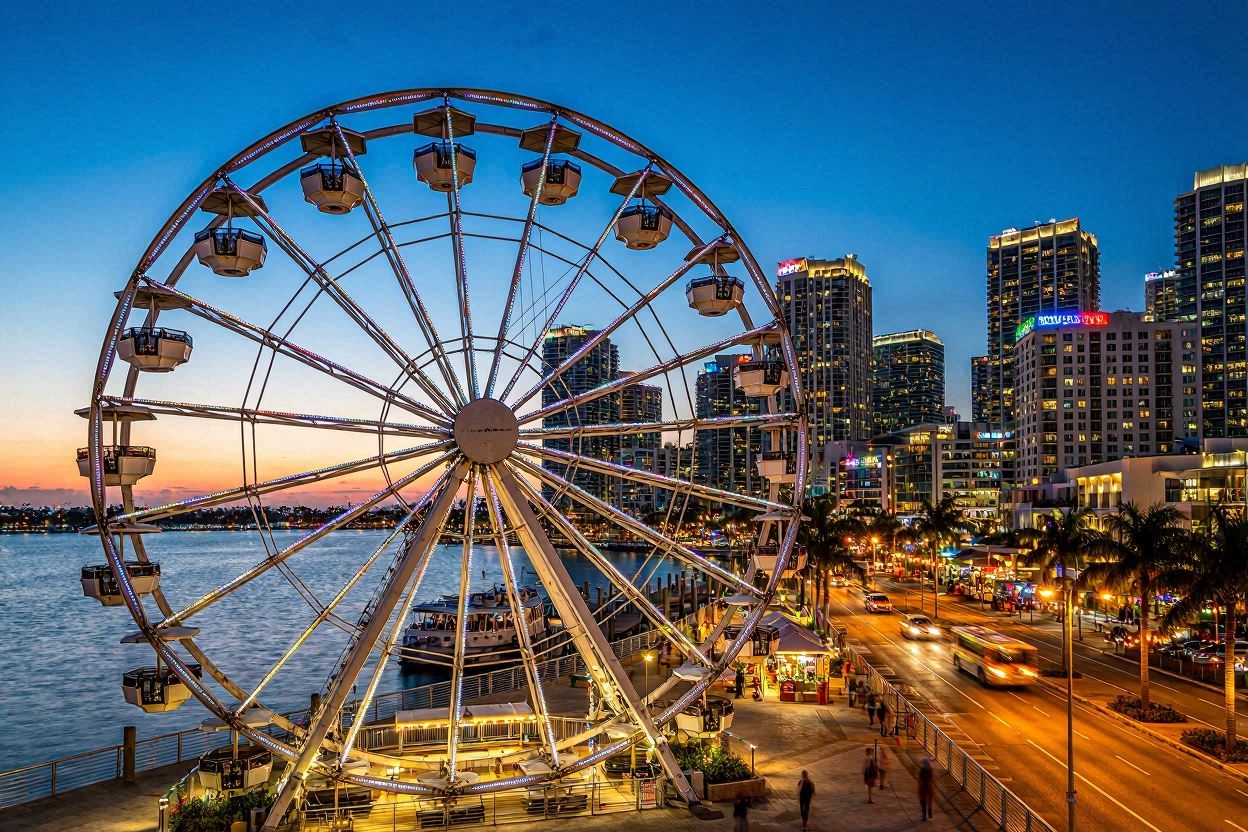
The Skyviews Miami Observation Wheel — Downtown, From the Air
There is a particular kind of silence that exists only inside a slow-moving glass capsule two hundred feet above Biscayne Boulevard. The Skyviews Miami Observation Wheel, anchored at the edge of Bayside, lifts you in unhurried revolutions — four to six per ride, each lasting between twelve and fifteen minutes — and in that gentle ascent, the city rearranges herself into something almost legible. The tangled highways untangle. The water reveals its true turquoise. The cruise ships in port become white chess pieces on a blue board.
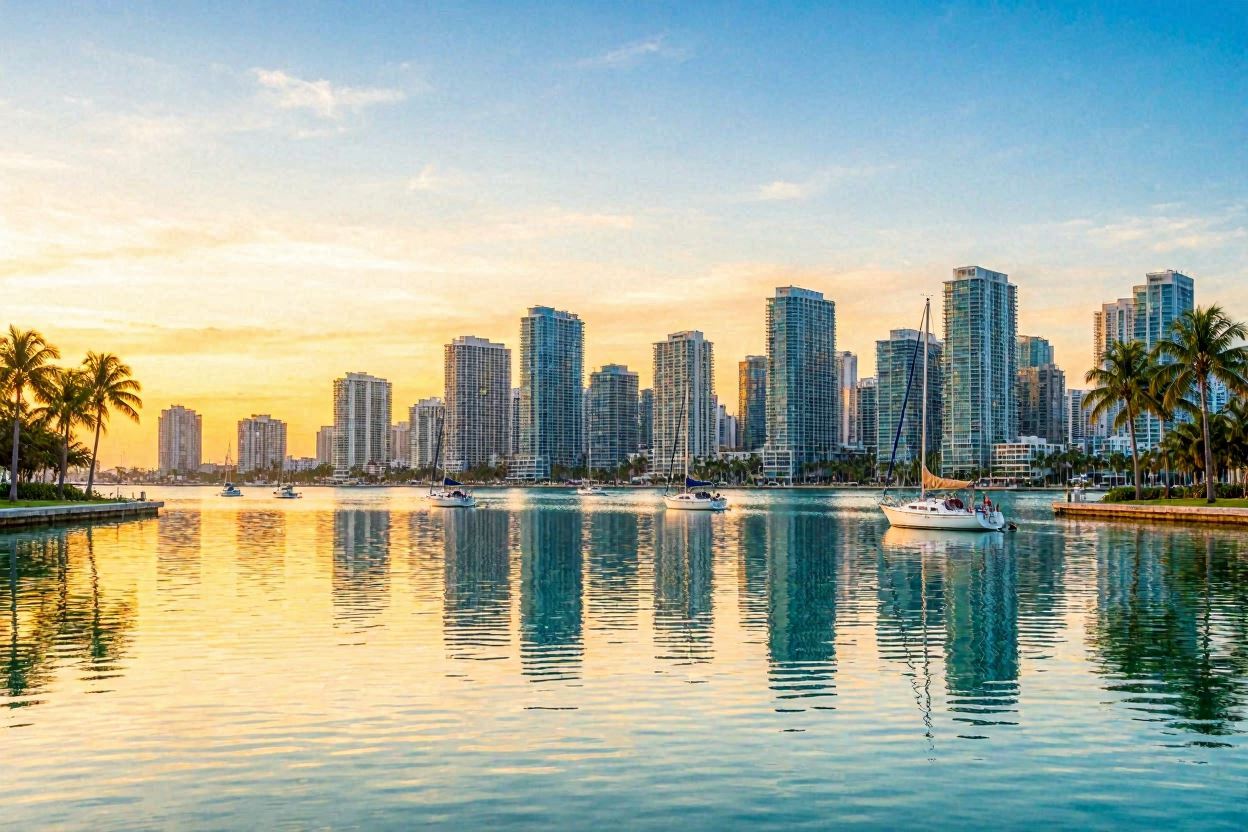
The photographers who know arrive thirty minutes before sunset, during the dry season between November and May, when the humidity drops and the atmosphere turns the color of molten copper. The sun’s reflection off the skyline at that hour is not merely beautiful — it is architectural. Light itself becomes a building material, gilding the glass towers of Brickell and turning the bay into a mirror so perfect that sky and water become indistinguishable.
Mandarin Oriental, Brickell Key — The Bay as Living Canvas
If the Skyviews wheel gives you altitude, the Mandarin Oriental gives you composure. Perched on Brickell Key — that singular island of privilege connected to the mainland by a bridge so short it barely registers — the hotel’s restaurant and lounge command what may be the most sophisticated waterfront view in the city. Biscayne Bay stretches before you like a painted backdrop, and the skyline rises from its opposite bank with the kind of symmetry that only occurs when developers and geographers accidentally collaborate.
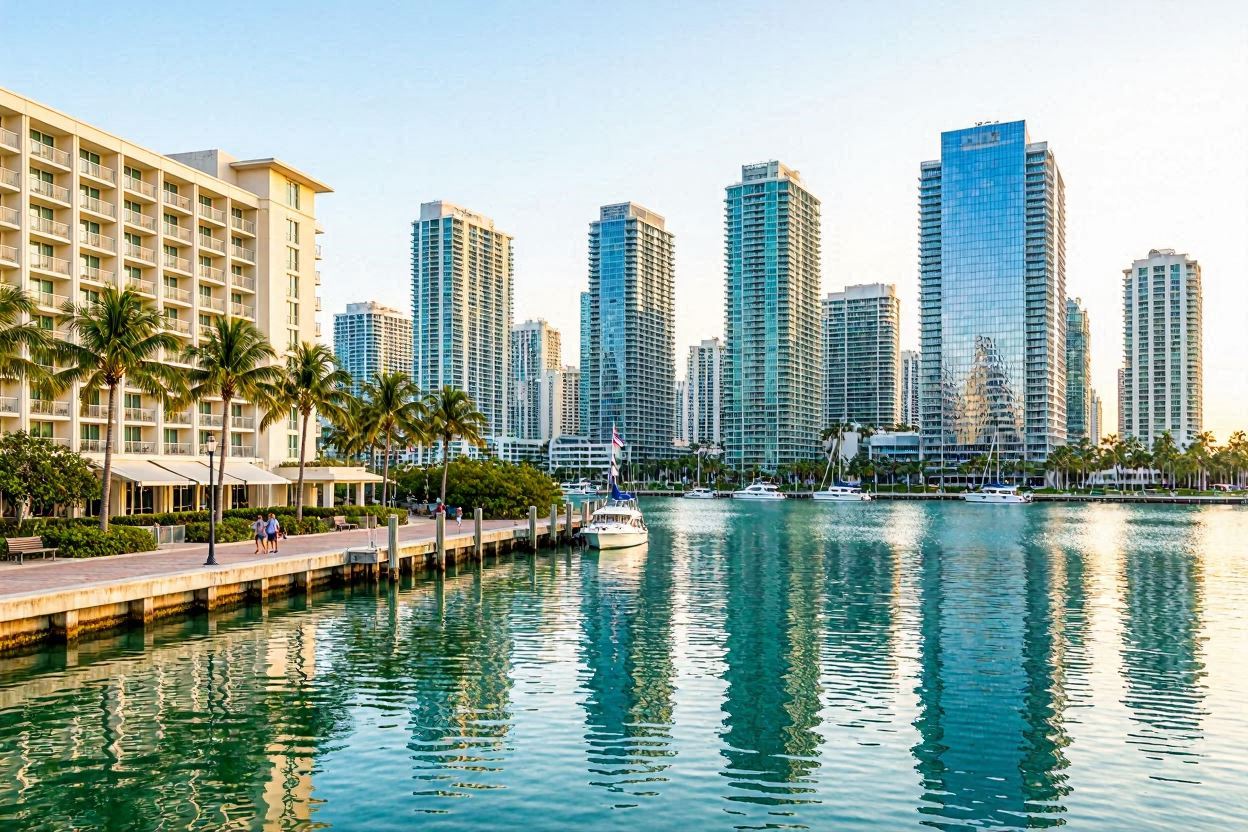
The angle is significant. From here, you see the city’s financial district at eye level — not looming above you, not receding into the distance, but sitting directly across the water as though posed for a portrait. La Mar by Gastón Acurio occupies this vantage, as does the MO Bar + Lounge, where a ceviche and a cocktail become the accessories to a view that costs nothing to absorb but everything to forget. Come at night, when the buildings illuminate and the bay becomes a second sky filled with inverted constellations.
Miami Circle Park — Where the Ancient Meets the Glass
There is a particular audacity in standing on one of the oldest known human settlements in North America while staring up at some of the newest buildings on the continent. Miami Circle Park, listed on the National Register of Historic Places, preserves the remains of a Tequesta archaeological site — a people who built here long before the first condominium broke ground. They chose this spot for the same reason photographers do: the downtown skyline, viewed from this southern bank of the Miami River inlet, arranges itself into a near-perfect vertical curtain of architecture.
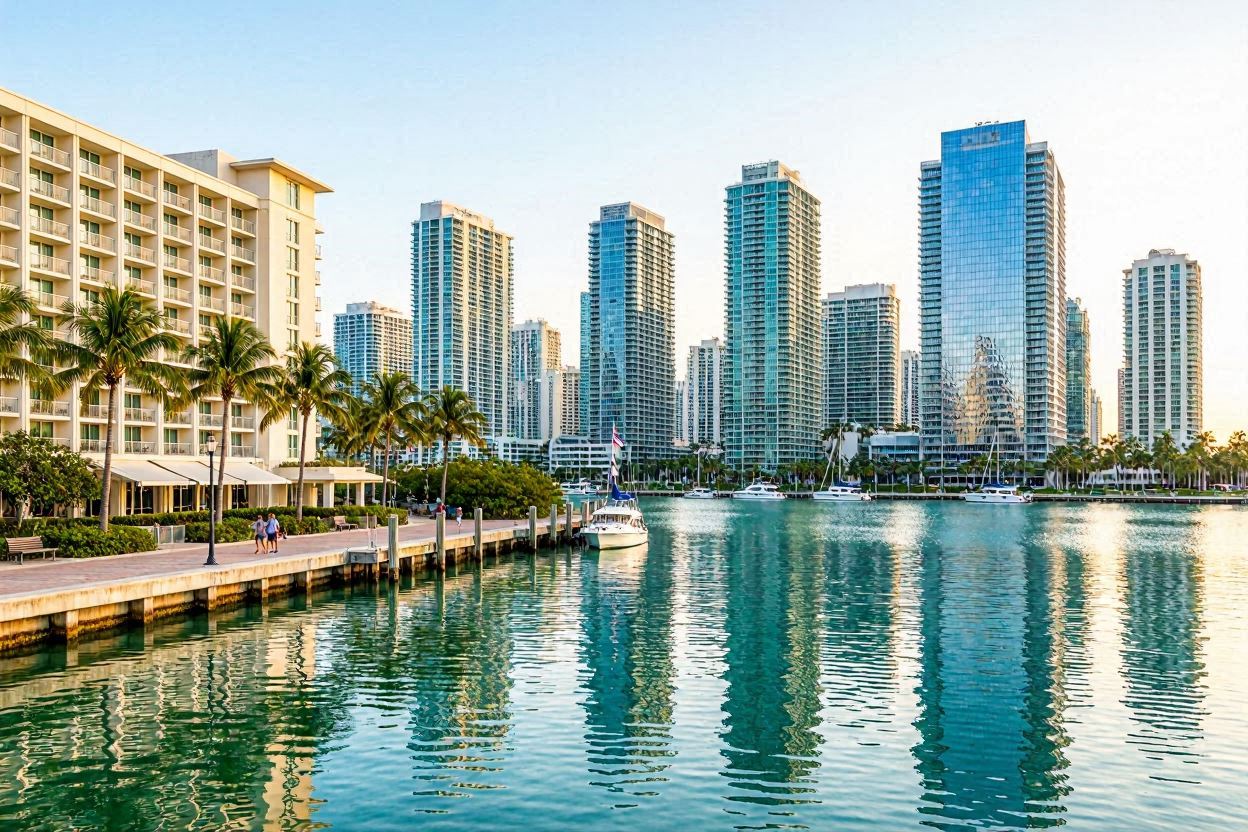
The park is free and open around the clock, which means the dedicated can arrive at dawn, when the glass towers catch the first horizontal light and the river lies flat as pewter. It is a view that compresses a thousand years of habitation into a single frame — the ancient limestone circle in the foreground, the twenty-first-century metropolis rising behind it, the bay dissolving into the Atlantic beyond both.
South Pointe Park — Where the Bay Marries the Ocean
At the southernmost tip of Miami Beach, geography performs a marriage ceremony. South Pointe Park sits at the precise confluence where Biscayne Bay surrenders to the Atlantic Ocean, and from its manicured lawns and wooden boardwalks, you witness the city from the opposite direction — not looking at the shoreline, but looking from it back toward downtown. The effect is transformative. Miami Beach, which moments ago surrounded you, now becomes a foreground peninsula. The skyline across the water becomes a destination. The cruise ships sliding past Government Cut become the punctuation marks of a working harbor.
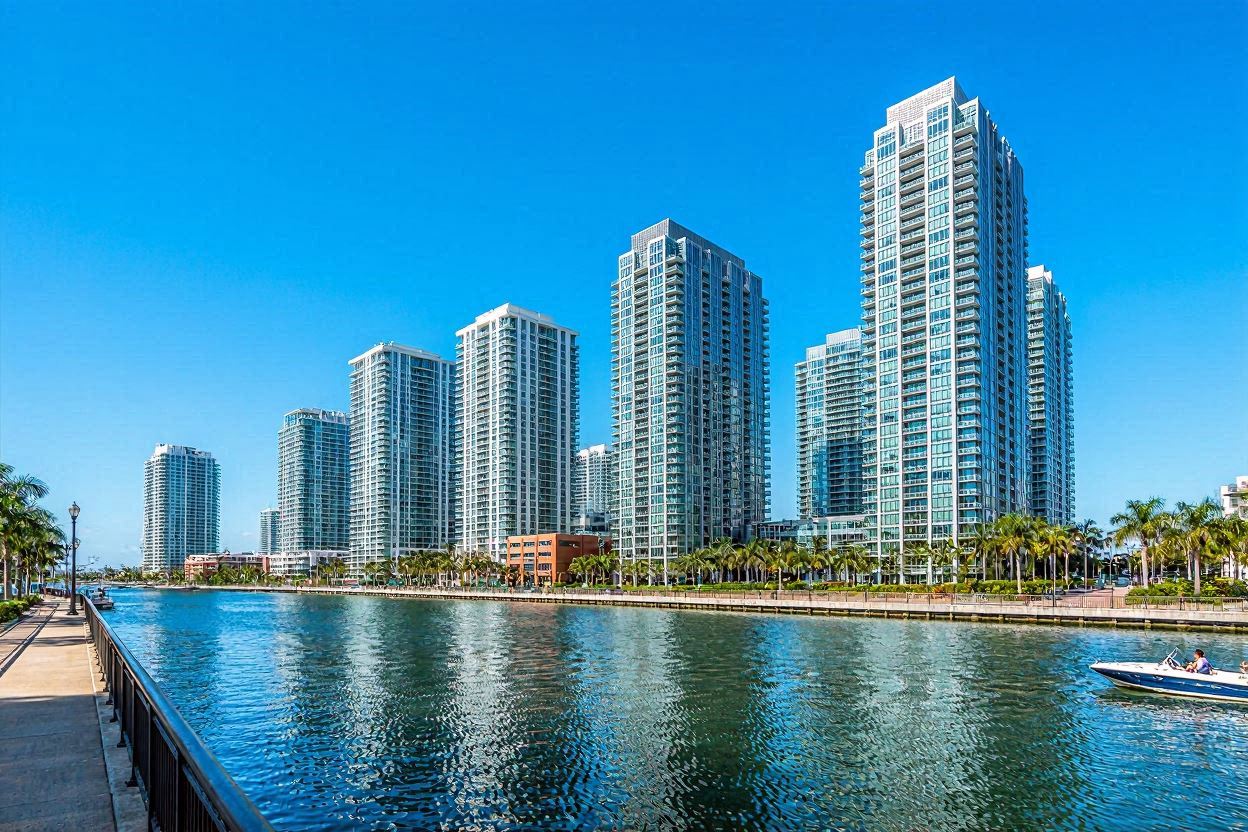
The photographers who understand Miami come here for the transitional light — the twenty minutes after sunset when the sky holds its last blue while the city lights ignite. In that narrow window, the skyline is simultaneously silhouette and illumination, and the ocean between you and it reflects both conditions at once. It is the single most photogenic stretch of public space in a city built for photography.
Lummus Park and Ocean Drive — The Postcard, Unmediated
Some views are so iconic they have been photographed into abstraction — you have seen them so many times on postcards and television screens that the real thing feels like a reproduction. Lummus Park, the thin green sliver between Ocean Drive and the Atlantic, is precisely such a place, and precisely the kind of view that must be seen in person to be believed. The pastel Art Deco hotels rise from the western edge like a painted theater set. The sand slopes gently to the east into an ocean so turquoise it appears color-corrected. Palm trees, planted at precise intervals, frame everything like borders on a stamp.
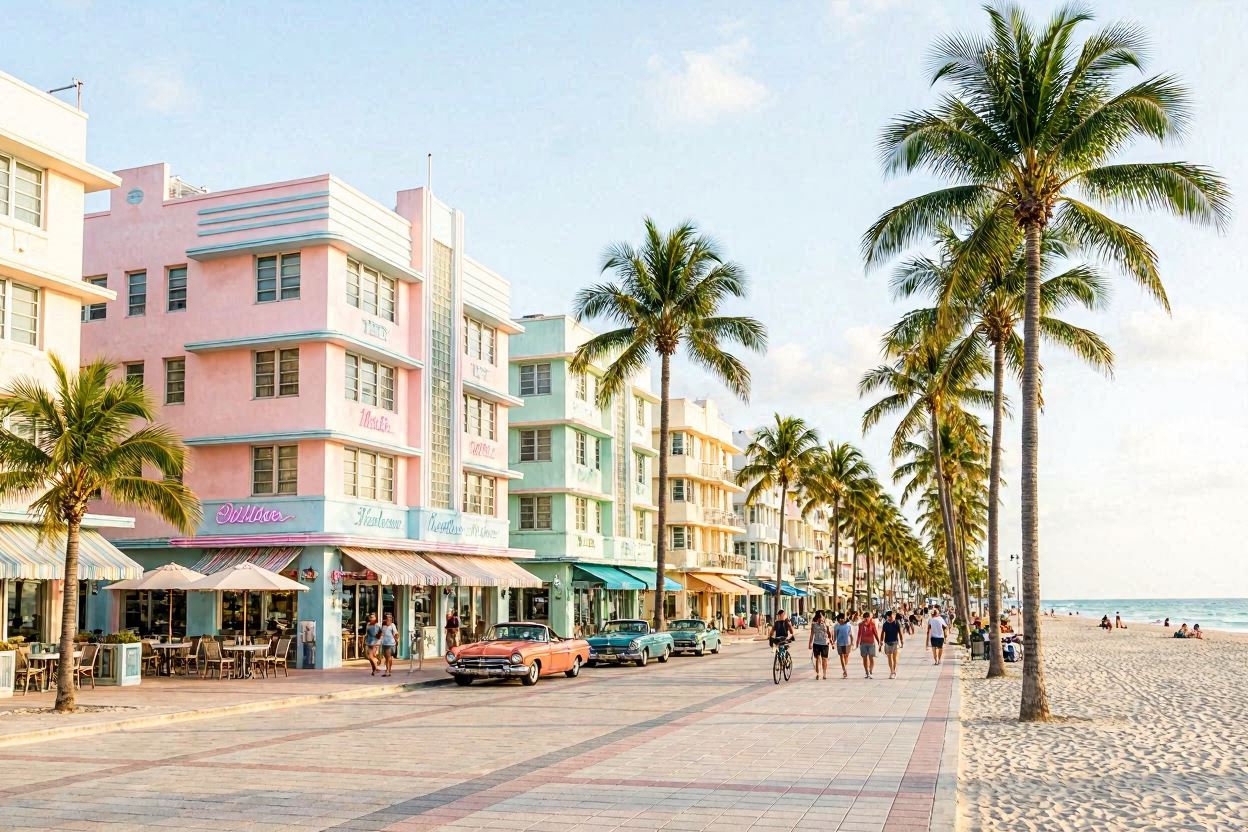
What the postcards cannot convey is the sound: the crash of surf on one side, the bass of passing cars and the chatter of sidewalk cafés on the other. Or the air: salt and exhaust and gardenia and cigar smoke, all at once, carried on a wind that never fully decides which direction to blow. This is the view that made Miami mythological, and it costs exactly nothing. Open twenty-four hours, Lummus Park is one of those rare instances where the most famous view in the city is also the most accessible.
MacArthur Causeway — The Cinematic Crossing
Some of Miami’s finest views are not destinations but passages — the views you absorb while moving between places, the ones you glimpse through a car window or from the deck of a causeway bridge. MacArthur Causeway, connecting downtown Miami to South Beach, is the most cinematic of these passages. The skyline rises to the west. The port spreads to the south. Watson Island and its strange collection of attractions — the Children’s Museum, the ruins of Jungle Island, the strange geometry of Maurice A. Ferré Park — occupy the middle distance. And ahead, always ahead, the powdery white coastline of South Beach beckons like a promise.
The causeway is best experienced as a pedestrian or cyclist on its dedicated path, where the pace allows the panorama to unfold properly. The southern ramp offers what may be the single most photographed skyline angle in Miami — the one where the buildings line up in a near-perfect row, each successive tower taller than the last, like an ascending scale in music. Park near the Children’s Museum and walk the ramp at golden hour. The view will reorganize everything you thought you knew about this city’s silhouettes.
Key Biscayne — The View From the Other Continent
Cross the Rickenbacker Causeway — itself one of the great drives in American geography — and you enter a different Miami entirely. Key Biscayne is a small island connected to the mainland by a low-lying bridge that traverses Biscayne Bay like a causeway through the Caribbean. The view from Bill Baggs Cape Florida State Park, at the island’s southern tip, looks back at the Miami skyline across twenty miles of open water and mangrove, and the city appears distant, almost fictional — a shimmer of vertical lines on the horizon, as though someone had placed a projected image against the sky.
This is the view for those who have seen Miami from every other angle and want to see it reduced to its essence. From Key Biscayne, the city is not a place you inhabit but a phenomenon you observe — a geological occurrence, a trick of light and concrete and money. The lighthouse at Cape Florida, the oldest standing structure in the region, anchors this perspective with two centuries of witness. It has watched Miami grow from mangrove swamp to global metropolis, and from its base, the view compresses that entire history into a single unobstructed line.
The View as Souvenir
Miami does not lack for viewpoints — she lacks for people patient enough to wait for the light to change. The observation wheels and rooftop bars give you altitude. The parks and causeways give you context. The ancient sites give you depth. But the view that stays with you — the one that surfaces unbidden years later, in the middle of a meeting or a sleepless night — is always the one you earned by arriving five minutes early, or staying five minutes late, or simply turning a corner and discovering that the city had been composing itself for you, waiting for someone with eyes to see.