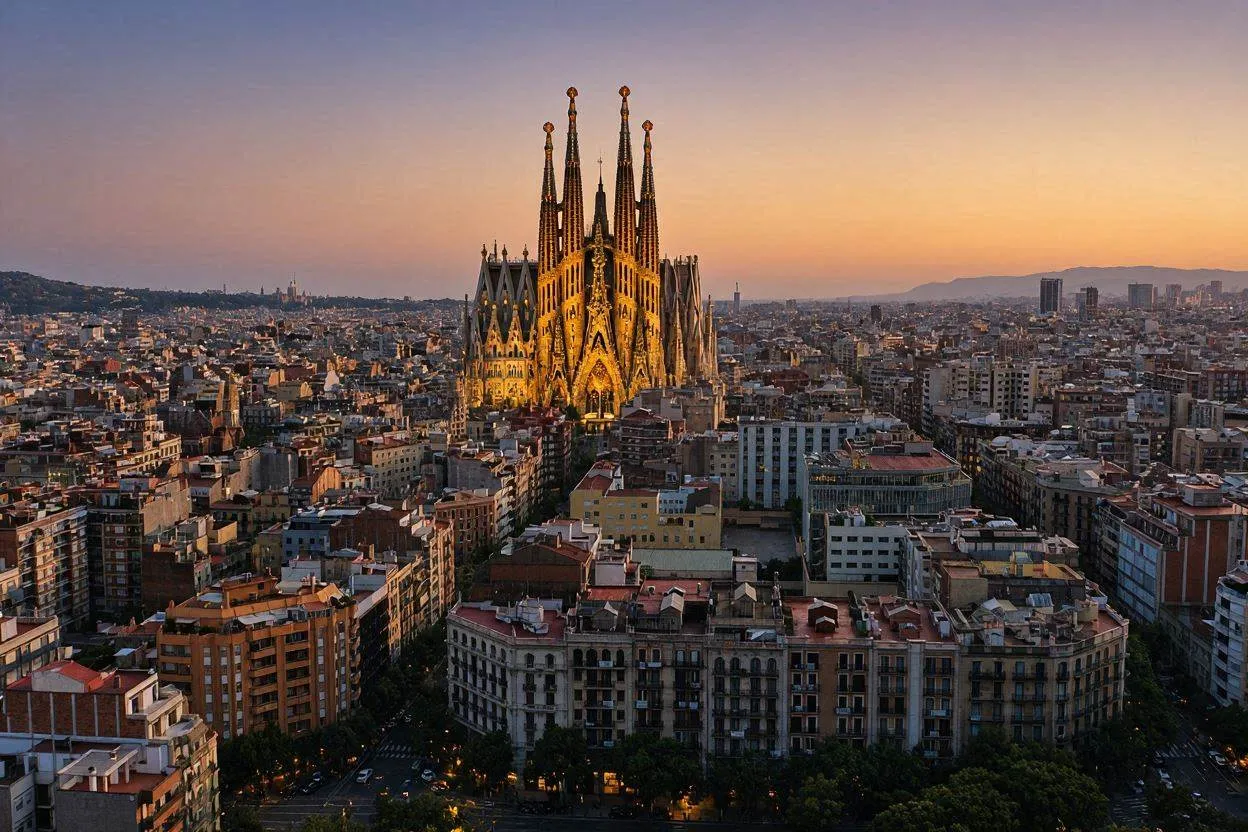
For 144 years, the Sagrada Familia has been Barcelona’s defining silhouette — a cathedral that grows like a living organism, stone by stone, funded by coins and faith. In February 2026, the final section of the Jesus Christ Tower was lowered into place, and Antoni Gaudí’s masterwork reached its full height of 172.5 metres, surpassing Ulm Minster in Germany to become the tallest church in the world. On 10 June 2026 — exactly a century after Gaudí’s death — Pope Leo XIV consecrated the new tower before tens of thousands of people.
The effect on visitors has been immediate: the basilica has never been in higher demand, and timed-entry tickets have never been harder to secure at the last minute. This guide covers everything you need to plan a visit in 2026 — which ticket to buy, how far in advance to book, when to arrive for the best light, and how to experience the building for free.
What Changed in 2026 and Why It Matters
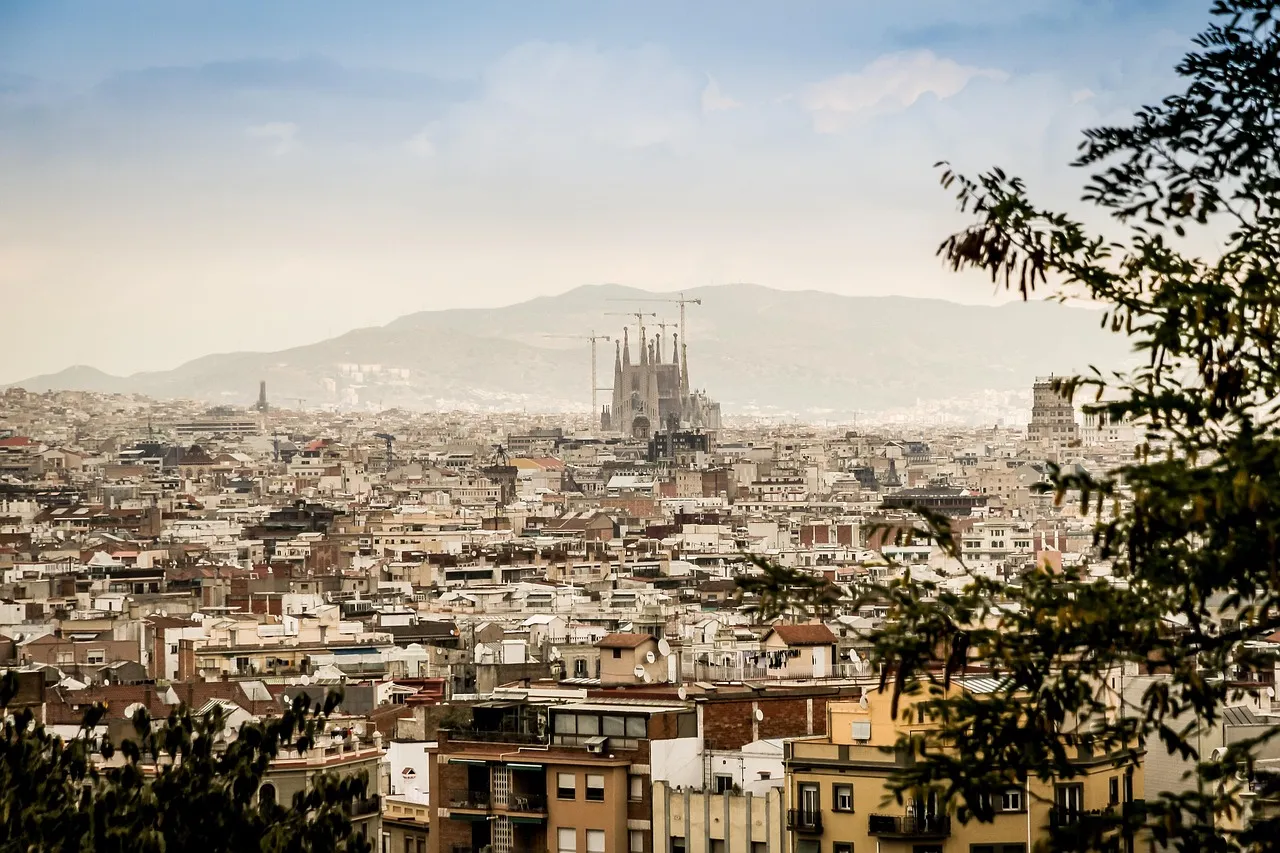
The completion of the central spire finishes the famous silhouette of eighteen towers: twelve dedicated to the apostles, four to the evangelists, one to the Virgin Mary, and the central Jesus Christ Tower. On 20 February 2026, a finial of glass and white ceramic was mounted atop the spire, crowning the structure at 172.5 metres — deliberately one metre shorter than the 177-metre summit of neighbouring Montjuïc Hill, embodying Gaudí’s conviction that no work of human hands should rise above the work of nature.
However, this does not mean the basilica is finished. Interior work on the central tower, including a public viewing platform, continues through 2027 and 2028. The Glory Facade — the monumental main entrance on the south side — is not expected to be completed until the mid-2030s. In practical terms, the exterior looks more magnificent than ever, while portions of the interior and the southern approach remain under construction. For visitors, the experience is richer than at any previous point in history.
Booking: Why You Must Plan Ahead
The single most important thing to know: the Sagrada Familia operates on timed-entry online booking. There are no traditional ticket booths at the entrance, and arriving without a ticket on the day will almost certainly end in disappointment.
Demand was enormous even before the tower was completed. In 2024, 4.83 million people visited — more than 13,000 per day. After the spire’s completion and the centenary of Gaudí’s death, that flow has only grown. Booking through an official platform with advance ticket sales or authorised ticketing partner guarantees a specific entry time.
As a 2026 guideline: in peak season (roughly June through September, plus Easter and Christmas), general entry tickets sell out 7–14 days in advance. On low-season weekdays, you might secure a slot a few days before. The simple rule: as soon as your dates are fixed, book.
Which Ticket to Choose
| Ticket Type | Price (2026) | What It Includes |
|---|---|---|
| Fast-track basilica entry | from €36.99 | Timed entry to the main nave and museum |
| Guided tour | from €56.00 | Expert commentary on symbolism and architecture |
| Guided tour + tower access | from €80.00 | Guided visit plus lift to a tower (Nativity or Passion) |
| Combined Park Güell + Sagrada Familia | from €82.00 | Two Gaudí landmarks in one guided tour |
Children under 6 are not permitted on the towers; visitors under 16 must be accompanied by an adult. Tower access involves a lift ascent and a spiral staircase descent, which is not suitable for those with limited mobility. Tower tickets sell out first — often weeks ahead in peak months.
The Light: When to Visit for the Most Spectacular Interior
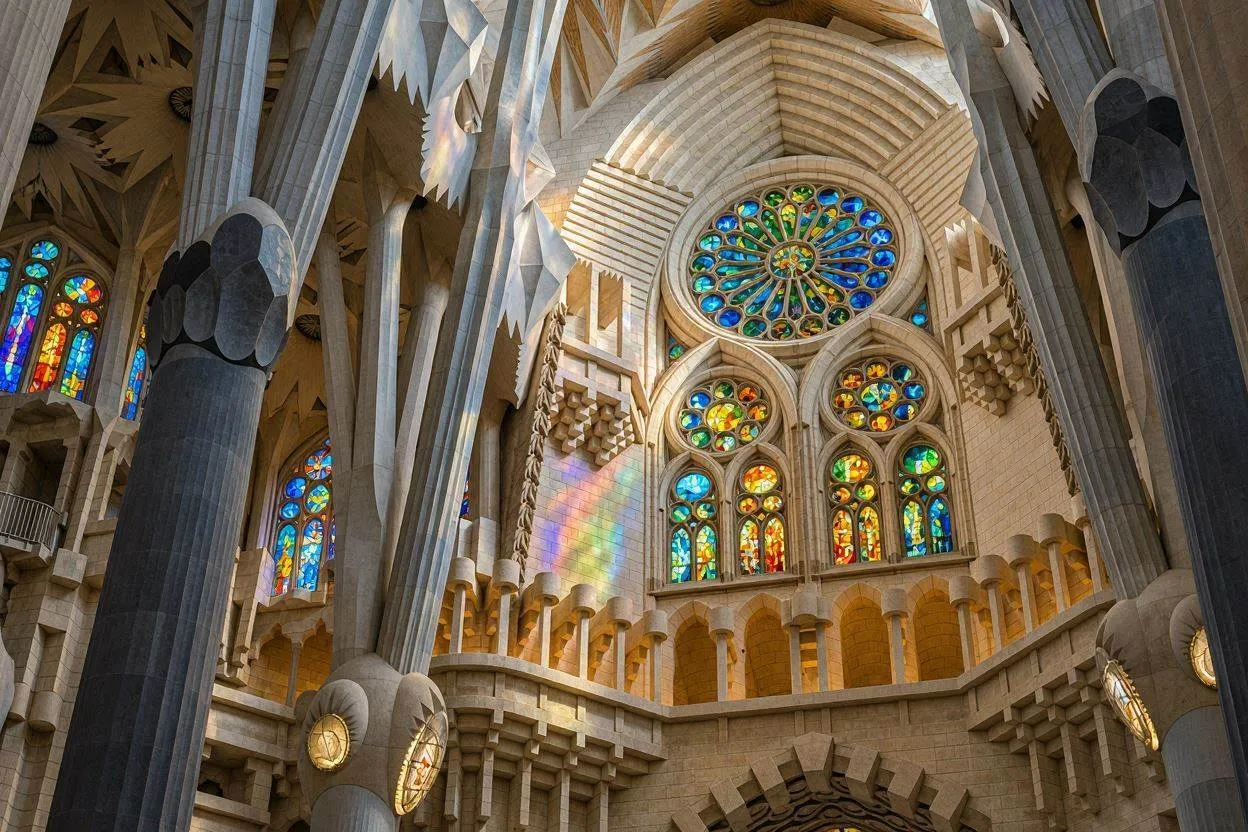
Gaudí considered light a building material, and the stained-glass windows are designed to track the sun. Windows on the eastern side — the Nativity Facade — glow in cool blues and greens, while the western Passion Facade blazes with reds, oranges, and golds. The interior changes character entirely depending on when you visit.
Morning (9:00–11:00)
Eastern windows are flooded with light, and the nave feels cool and contemplative. From 9:00 to 10:00, the basilica observes a “silent hour” — visitors are asked to maintain quiet and use headphones — making the first session especially peaceful.
Late Afternoon (16:00–18:00)
The sun moves west and the Passion Facade windows fill the space with warm, dramatic colour. This evening performance is the most photographed, so if light matters to you, choose a slot in the second half of the day.
Opening Hours (April–September)
| Day | Hours |
|---|---|
| Monday–Friday | 9:00–20:00 |
| Saturday | 9:00–18:00 |
| Sunday | 10:30–20:00 (delayed opening for international mass) |
Always confirm the current schedule when booking, as hours adjust seasonally.
Inside the Basilica: A Forest of Stone
Step through the threshold and the building reveals its purpose. Gaudí’s columns rise and branch like a forest of stone, splitting into ever-thinner branches to support the vaults — the ceiling reads not as a roof but as a living canopy. Combined with the coloured light, this creates a sensation found in no other church interior in the world.
The Three Facades
- Nativity Facade (east): Completed during Gaudí’s lifetime and inscribed as UNESCO World Heritage in 2005, this is the most ornate face of the basilica — richly carved with plants, animals, and figures celebrating the birth of Christ.
- Passion Facade (west): Angular, austere sculptures by Josep Maria Subirachs deliberately contrast the Nativity with a stark depiction of Christ’s final days.
- Glory Facade (south): The monumental main entrance, still under construction and not expected to be finished until the mid-2030s.
The Crypt and Museum
The crypt, in the lower level of the basilica, is a functioning parish church where regular masses are held. It also houses the tomb of Antoni Gaudí. The on-site museum displays Gaudí’s original models, drawings, and the inverted hanging-chain models he used to calculate the daring geometry of the structure.
Plan at least 90 minutes for the basilica and museum; allow roughly two and a half hours if you are joining a guided tour or ascending a tower.
How to Visit for Free: Masses and the Crypt
While standard tourist entry requires a paid ticket, there are legitimate ways to enter the Sagrada Familia without paying — by attending a religious service rather than visiting as a tourist.
The Two Realities Inside the Temple
It is important to understand that the Sagrada Familia contains two distinct spaces:
- The upper basilica — the vast nave with columns and stained glass, accessed by paid tickets during tourist hours.
- The crypt — the lower level, a functioning parish church where regular masses are held and where Gaudí is buried.
Free Entry to the Upper Basilica via Mass
| Service | Day | Time | Language |
|---|---|---|---|
| International mass | Sunday | 09:00 | Multilingual |
| International mass | Saturday | 20:00 | Multilingual |
Access for both services is through the Nativity Facade (Carrer de la Marina). Entry is free, but capacity is limited. Arrive 60–90 minutes early, particularly during high season — people gather before dawn, and entry may close once capacity is reached.
This is a worship service, not a tourist visit. Dress respectfully (shoulders and knees covered), maintain silence, and do not occupy central seats if you are attending as an observer rather than a worshipper. Photography is generally permitted, but without flash and without disrupting the service.
Free Entry to the Crypt
The crypt hosts regular masses throughout the week with much easier access than the upper basilica:
| Day | Time | Language |
|---|---|---|
| Daily | 20:00 | Catalan |
| Sunday | 09:00 | International (upper basilica) |
| Sunday | 10:30 | Catalan |
| Sunday | 13:00 | Catalan |
| Sunday | 18:30 | Catalan |
Crypt access is usually through a separate entrance on Carrer de Sardenya, and the crypt fills more quickly than the upper basilica for services.
Fourteen Facts That Make Sagrada Familia Unlike Any Other Building
The more you learn about this cathedral, the more extraordinary it becomes:
-
The longest-running construction project in modern history. The first stone was laid on 19 March 1882. By 2026, the temple had been under construction for 144 years.
-
Funded entirely by donations. The basilica does not belong to any government body and receives no public funding. Its full name — Expiatory Temple of the Holy Family — reflects the concept: the public donates toward construction in expiation of sins.
-
It was not originally in Barcelona. When construction began, the land was in the town of Sant Martí de Provençals, a separate municipality absorbed into Barcelona only in 1897.
-
It was illegal until 2019. The Sagrada Familia had no building permit for most of its existence. In June 2019, the city issued an official licence — the most expensive in Barcelona’s history, costing €4.63 million.
-
A church turned inside out. Most historic churches are filled with religious artefacts — altarpieces, paintings, icons. Gaudí deliberately left the interior almost empty. While the facades feature hundreds of sculptures, inside there are only four — yet the space is no less overwhelming.
-
Completion will cost approximately €374 million. A modest sum compared to the reconstruction of Notre-Dame — funded entirely by ticket revenue and donations.
-
Gaudí was not the first architect. The original idea belonged to bookseller Josep Maria Bocabella and priest Josep Manyanet. The first architect was Francisco de Paula del Villar, who was replaced by the 31-year-old Gaudí in 1883.
-
The tallest church on Earth. At 172.5 metres, it surpassed Ulm Minster (161.5 metres) in February 2026. Gaudí chose this height deliberately — one metre below Montjuïc Hill (177 metres), so no human creation would exceed nature’s.
-
One of the ten most visited monuments in the world. In 2024, 4.83 million people visited — more than 13,000 per day.
-
Built from stone, not concrete. Despite its scale and era, the primary material is stone — specifically sandstone. When the original Montjuïc quarries closed, the construction team sourced over 60 types of sandstone from Europe, Asia, Africa, and South America, along with granite from Galicia, blue granite from Brazil, porphyry from Iran, marble from Andalusia, travertine from Italy, and basalt from Catalonia.
-
Gaudí is buried inside. His tomb lies in the Chapel of Our Lady of Mount Carmel in the crypt, where masses are still held.
-
Gaudí may become a saint. The Catholic Church has begun the process of beatification, citing his deep faith and dedication to the temple.
-
The building survived the Spanish Civil War. During the war, revolutionaries burned the workshop and destroyed many of Gaudí’s original drawings — but the structure itself was spared.
-
Each ticket contributes to completion. Every visit funds the next chapter of construction — your entry fee is a donation toward finishing one of the most ambitious architectural projects in human history.
The Towers: What You Need to Know
You choose one tower — either the Nativity or Passion side — and ascend by lift. The descent is on foot via a narrow spiral staircase, which is why restrictions apply:
- Children under 6 are not permitted
- Visitors under 16 must be accompanied by an adult
- The descent is not suitable for those with limited mobility
- Tower access may be suspended in bad weather
Lift capacity is limited, so only a small fraction of daily tickets include tower access — and these sell out first. If tower views are a priority, book a guided tour with tower access as early as possible.
Getting There
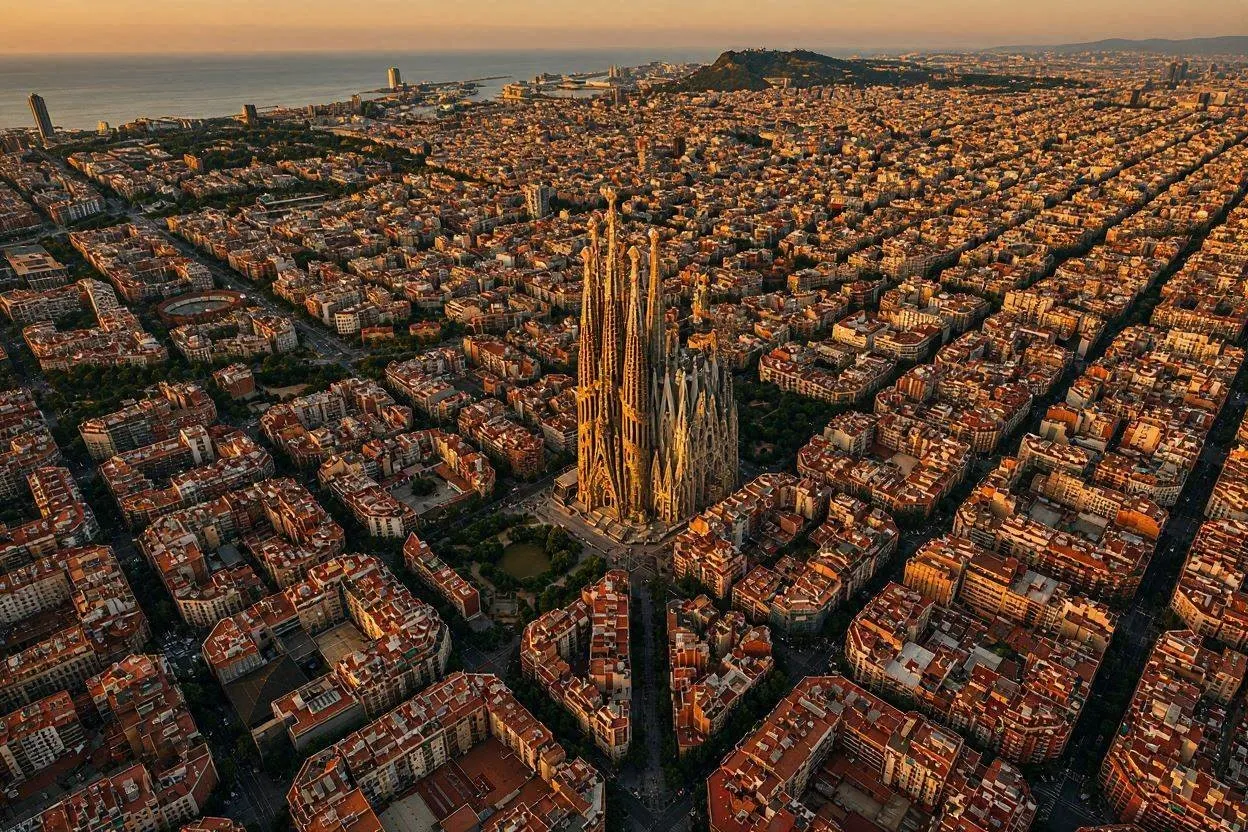
The basilica is in the Eixample district, easily reached by metro:
| Method | Details |
|---|---|
| Metro | Sagrada Familia station (Lines L2 and L5) — exits directly at the Nativity Facade |
| Bus | Lines 19, 33, 34, 50, H10, V21 |
| Walking | 10 minutes along Avinguda de Gaudí from Hospital de Sant Pau |
Beyond the Basilica
A 10-minute walk along Avinguda de Gaudí leads to Hospital de Sant Pau, a magnificent and far quieter Modernista complex that makes a perfect continuation of your walk. For a full Gaudí day, combine the basilica with Park Güell (mosaics and panoramic city views), Casa Batlló, and La Pedrera (Casa Milà) on Passeig de Gràcia.
Practical Checklist
Before you go:
- Book your timed ticket online as soon as dates are confirmed
- Decide whether you want tower access (costs more, sells out faster)
- Check the weather — tower visits may be suspended in high winds or rain
On the day:
- Arrive 15–20 minutes before your timed slot for security screening
- Dress for a place of worship (shoulders and knees covered)
- Bring headphones if you want audio commentary during the silent hour (9:00–10:00)
During your visit:
- Allow 90 minutes minimum for the basilica and museum
- Allow 2.5 hours if including a guided tour or tower ascent
- Photography is permitted, but no flash, tripods, or selfie sticks
A Building That Outlived Its Architect
Antoní Gaudí was hit by a tram on 10 June 1926 and died three days later. He was 73. By that point, only a small fraction of the basilica had been completed — the Nativity Facade and the crypt. He spent his final years living in a workshop on the construction site, dressed in worn clothes, mistaken by some as a beggar.
A century later, his cathedral is the tallest church in the world, a UNESCO World Heritage Site, and one of the most visited monuments on the planet. It has been burned, bombed, criticised, mocked, and admired — and it is still growing. Every ticket purchased contributes another stone to a project that will outlive everyone who reads this guide.
That is the point of the Sagrada Familia. It was never meant to be finished in a lifetime. It was meant to be finished.