
There is something architecturally odd about buying Christmas tree ornaments in July. June is understandable — close enough to the midpoint of the year to Aand start fantasizing about winter. But July is peak summer, peak patio, peak barbecue. Pinterest’s shopping-trends data for the second quarter of 2024 does not care. It registers a thirty-seven percent month-over-month increase in outbound clicks for seasonal and Christmas decorations, placing the category third among all product verticals the platform tracks — behind only night lights and backpacks. Holiday décor is being browsed, saved, and clicked through to purchase while the Northern Hemisphere is still in shorts.
The trend is not an aberration. It is, increasingly, a pattern. And the objects driving it are not the ones you might expect — there is no evidence of consumers stockpiling wrapping paper in July. What they are buying instead reveals something specific about how the modern holiday season is being reshaped by early planning, vintage aesthetics, and a refusal to wait until November.
The Premature Optimizer

The Thirty-seven percent jump makes more sense when you trace its likely cause. Supply-chain anxiety, learned during the pandemic years, has settled into a permanent bass note in consumer behavior. Holiday products that ship from overseas carry delivery risk; buying in July neutralizes that risk. Amazon’s search results for “Christmas decorations 2024” already return over two thousand listings featuring the year explicitly — ornaments commemorating the year, door toppers dated 2024, and keepsakes designed to mark a specific holiday season. This “year-in-review” subcategory is itself a trend, with ornaments printed with the year’s viral moments and trending topics selling at entry prices around three to seven dollars.
The logic is straightforward. Buy early, avoid the December rush, and have the decoration on hand when the mood strikes rather than when the calendar demands. It is the material equivalent of buying winter coats in April — cheaper, quieter, and far less performative.
Glass Keepsakes: The Year-in-Review Ornament

The 2024 Year in Review Transparent Glass Keepsake Ornament ($3.49) is an unlikely top-of-page product. It carries just twenty-four ratings at 4.4 stars and is not a mass-market bestseller by Amazon standards. But it represents an emerging product type: the commemorative ornament that marks the year itself rather than a holiday motif. These are objects designed not for children but for adults who collect ornaments the way others collect stamps — deliberately, annually, with each edition tied to a specific calendar moment. The year printed on the surface becomes a memory anchor. Five years later, you remember 2024 by reaching into the ornament box and finding this one.
This subcategory did not exist at scale before social media normalized the concept of yearly “highlights” content. It exists now because we have been trained to think of each year as a narrative — and narratives deserve physical artifacts. The ornament is the artifact.
Door Toppers: Décor Where You Least Expect It

If glass ornaments are the traditional end of the spectrum, the door-frame topper is the absurd end. The 2024 Christmas Door Topper ($6.88 to $7.88) sits on the top edge of a doorway, where a person rarely looks, and announces the season with a snowman or Santa silhouette. It is the kind of product that would have seemed like a joke item in 2018 and now has 467 ratings at 4.1 stars — modest but enough to signal real adoption. What it represents is a broader appetite for holiday décor in unexpected places: not just the tree, not just the mantle, but the threshold, the doorway, the transition space between rooms. Holiday décor is migrating from the centerpiece to the periphery.
The Vintage Farmhouse Revival

Eight thousand Amazon results for “vintage christmas tree decorations” is the number that tells the real story. The top sellers in this subcategory are not plastic or glass — they are wood. The Huwena Vintage Christmas Ornaments wooden cutouts carry 282 ratings at 4.6 stars and move over fifty units a month. The Outus 16-piece vintage ball ornament set at $19.99 carries 421 ratings. The aesthetic is farmhouse, rustic, deliberately imperfect — the kind of tree decorations that look inherited rather than purchased.
What the vintage revival signals is fatigue with mass-produced Christmas aesthetics. The bright, uniform, plastic-and-tinsle tree has not disappeared, but it has been joined by a competing vision: a tree that looks like it came from a farmhouse attic, curated by someone who cares about texture more than shine. Wood, glass, muted tones, and hand-finished imperfections are the signals. The vintage tag on Amazon is not a niche — it is one of the highest-volume queries in the category.
The Party-Supply Layer
Not all seasonal décor is meant to last. The FECEDY Merry Christmas Banner Set — paper fan flowers, confetti dots, hanging garlands, and swirl streamers — moves over a hundred units a month at under fifteen dollars. It carries 219 ratings at 4.4 stars. This is the party-supply layer of Christmas décor — the single-use, photo-ready, social-backdrop segment. It exists because the holiday is now experienced as much through images as through presence. A banner that photographs well is worth more than a banner that lasts ten years.
The More-Distant Layer
(Christmas window lights at night, warm glow — image to be added)
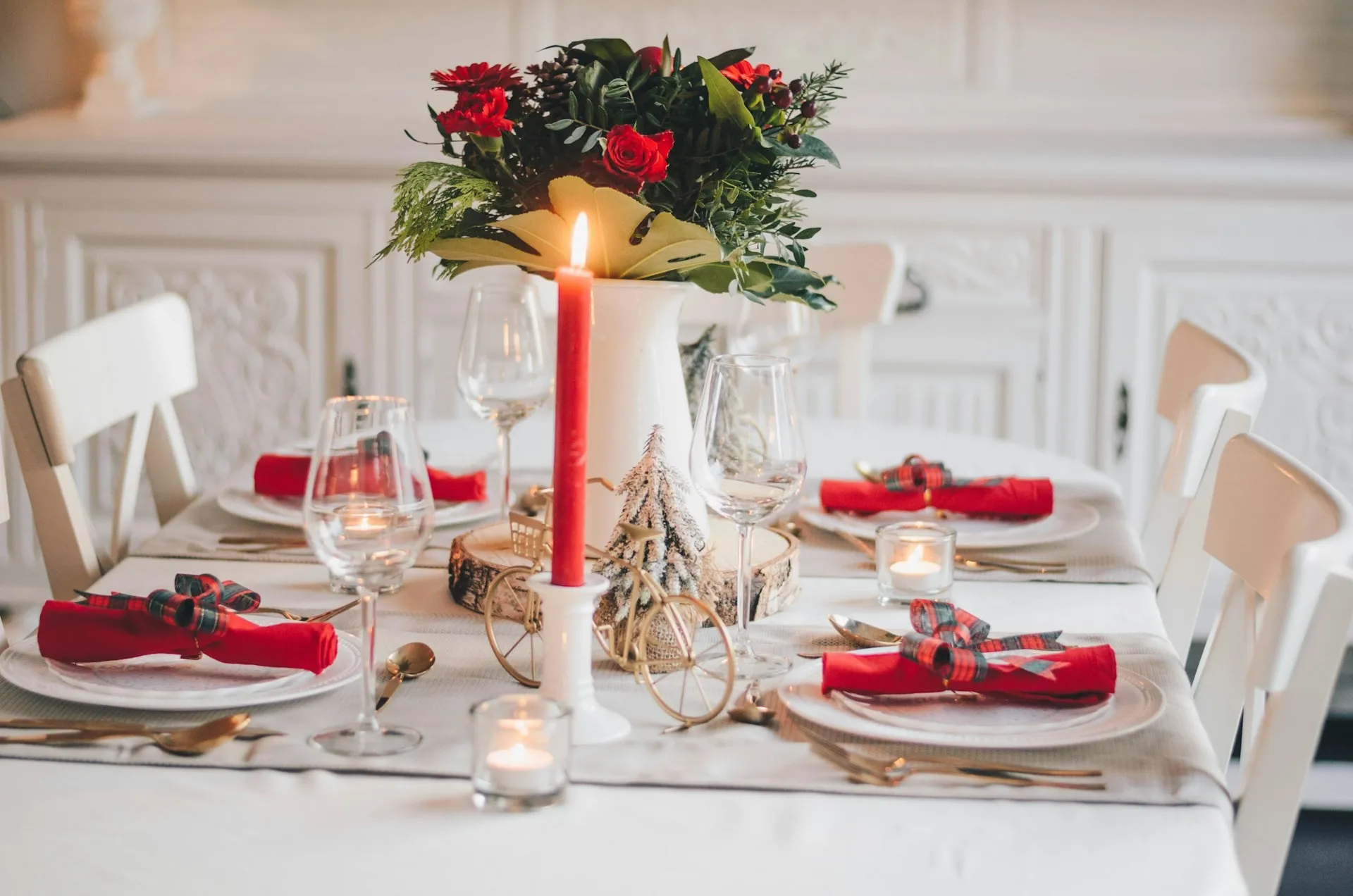
What ties these subcategories together is quiet-luxury taste, deliberately planning the holiday season around mood rather than obligation. Year-in-review ornaments celebrate the passage of time. Door toppers make space meaningful. Vintage wooden decorations return texture and imperfection to the tree. Party banners create social moments worth photographing. None of it is necessary. All of it is intentional. And the intention begins earlier every year.
Why This Quarter Specifically
A thirty-seven percent month-over-month jump in July is not a fluke; it is the result of Pinterest users planning six months ahead — and Amazon sellers adjusting their inventory to match. Here is what is actually happening in the data:
- Early planners. Pinterest saves accumulate earlier than purchases. What we are seeing in Q2 is the save signal; the purchase signal will follow by November. The surge indicates that consumers are beginning holiday décor research now.
- Year-specific products. Products with “2024” printed on them must be manufactured before December. Sellers list early to capture pre-orders; consumers browse early to secure specific editions.
- Vintage demand. The farmhouse aesthetic changes slowly, which means a vintage ornament bought in July is not obsolete by November. There is no freshness penalty for buying early.
- Supply anxiety. A non-trivial share of holiday décor is shipped from overseas. Buying in July removes the delivery-risk premium that peaks in November and December.
- Budgeting. Spreading holiday spending across six months rather than six weeks is a financial strategy more households have adopted since 2020. July browsing for December objects is part of it.
The Verdict
The Christmas-in-July trend is not, as one might suspect, an excess of holiday spirit. It is a series of rational economic adjustments layered on top of a cultural shift in how the holiday is designed and experienced. The vintage farmhouse ornament is a deliberate rejection of flash. The year-in-review keepsake marks a moment in a way that outlasts the moment. The door topper decorates a space most of us ignore. The party banner is bought for its image, not its permanence.
And buying them all in July is not about being early. It is about being intentional. The Christmas that is planned in July is not the one that happens in December regardless — it is the one that reflects actual choices rather than last-minute defaults. In a season that has long been defined by obligation, choosing deliberately and early is its own quiet revolution.
Which is perhaps the most interesting trend of all — not that we are decorating earlier, but that the decorating is no longer something we just do. It is something we decide to do.