There is an unspoken truth in the world of flowers: the most exquisite blooms do not, on their own, make an exquisite bouquet. A handful of garden roses — even the most perfumed, even the most ruby-lipped — can fall flat when arranged without intention. The art of the bouquet is just that: an art. It demands an eye for color, a respect for form, and an understanding that every stem you place carries weight, symbolism, and texture. When a bouquet truly works, it does not merely sit in a vase — it commands a room, shifts a mood, and lingers in memory long after the last petal has fallen.
This is a guide for those who refuse to treat flowers as an afterthought. Whether you are selecting a single stem for a nightstand or composing a grand gesture for a celebration, the principles that follow will transform the way you think about floral design — elevating it from simple gift-giving to a considered curatorial act.
Selecting Blooms of Distinction

A truly luxurious bouquet always begins with the quality of its individual components. No amount of artful arrangement can compensate for flowers that have already begun to surrender their vitality. When selecting blooms, train your eye on three essential markers of health and freshness:
The buds — They should be firm, with petals that feel substantial between your fingers. Avoid blooms where the outer petals have begun to curl inward or brown at the edges.
The leaves — Foliage tells the story of a flower’s journey. Look for leaves that are taut and bright, with no signs of wilting, yellowing, or spotting. Limp foliage at the stem is a clear signal that the flower has been out of water for too long.
The stems — A crisp, green stem with a clean cut at the base suggests the flower has been recently harvested and properly hydrated. Stems that appear slimy or discolored near the cut should be avoided entirely.
When composing a bouquet from multiple varieties, you must also consider how their forms will interact — the architecture of each bloom, the length and flexibility of their stems, and the visual weight they bring to the arrangement. A peony’s voluptuous ruffle demands a very different environment than the spare elegance of a calla lily.
Why Thoughtful Selection Matters
The flowers you choose determine far more than mere aesthetics. They set the tone for the entire composition:
- Visual coherence — A well-curated selection creates a composition that feels intentional rather than chaotic.
- Volume and silhouette — The right combination of blooms gives the bouquet its three-dimensional presence and sculptural quality.
- Symbolism and sentiment — Flowers have spoken a language of their own for centuries. A red rose is not simply a red rose — it is a declaration.
- Longevity — Choosing flowers at the peak of their vitality ensures the bouquet remains beautiful for days rather than hours.
Poorly paired blooms result in a bouquet that appears lopsided, restless, or visually discordant. But beyond color clashes, there is a more invisible danger: certain flowers simply cannot coexist. Some release compounds into the water that shorten the life of their companions — a quiet act of botanical sabotage that only knowledge can prevent.
The Seasonal Advantage
There is a quiet luxury in choosing flowers that belong to the season. Seasonal blooms offer something that imported hothouse flowers never quite achieve: a vividness and vitality that comes from being in harmony with the natural world. A chrysanthemum in November, for instance, is not merely available — it is at its zenith. During its peak season, it fully unfurls its layered petals, releases its characteristic fragrance with abandon, and holds its freshness with an endurance that out-of-season specimens cannot match.
The principle is simple: when you choose flowers at the height of their season, you are choosing flowers at the height of their beauty. This is how true floral harmony is achieved — not through force or artifice, but through attentiveness to nature’s own calendar.
Flowers for the Occasion
Every occasion whispers its own floral preference, and the most memorable bouquets are those that listen. A grand romantic gesture calls for the unapologetic opulence of roses — the deeper the crimson, the more unmistakable the message. For a youthful spirit, the unaffected charm of daisies, cornflowers, or wildflowers speaks volumes without saying too much. A first date? Consider the hopeful delicacy of primroses, their pastel shades suggesting possibility without presumption.
Formal occasions demand flowers of a certain architectural discipline — blooms with clean lines and restrained beauty. A birthday, on the other hand, is the moment to honor personal taste above all convention: choose what the recipient loves, and the gesture becomes infinitely more thoughtful. Milestone celebrations — anniversaries, jubilees — invite flowers of substance and drama: calla lilies with their sculptural poise, chrysanthemums in their rich autumnal tones, sunflowers that radiate warmth, the confident cup of a tulip, the lush abandon of a peony, and of course, the enduring rose in all its many expressions.
When in doubt, the answer is never to default to something generic. A curated bouquet — one that reflects thought, intention, and a genuine understanding of both the occasion and the recipient — transforms a simple gift into an experience.
The Chromatic Instinct: Mastering Color in Floral Design
 Color is the first thing the eye registers, and the last thing the heart forgets. In bouquet design, color is not merely decorative — it is the emotional architecture of the arrangement. Getting it right requires more than simply choosing pretty flowers; it requires understanding how hues interact, how contrast creates energy, and how harmony creates repose.
Understanding Floral Compatibility
Not all flowers make willing companions. Some, quite literally, poison one another’s water. The daffodil, for instance, releases a dense sap into the water that blocks the stems of other flowers, effectively cutting off their supply of moisture. This is why daffodils are almost always presented as monobotanical arrangements — elegant on their own, dangerous in mixed company.
Several other flowers are best left to stand alone:
- Mignonette (Reseda) — Its subtle beauty deserves a solo stage.
- Orchids — Too particular in their needs to share water comfortably.
- Carnations — Surprisingly territorial in a shared vase.
- Lilies of the valley — Delicate and best admired in isolation.
- Lilies — Their pollen and water-altering properties make them challenging companions.
There are also specific pairings that simply must be avoided — botanical rivalries that result in mutual decline:
- Lilies of the valley and violets
- Forget-me-nots and daffodils
- Roses and lilies of the valley
- Forget-me-nots and tulips
Beyond these practical considerations, pay close attention to the shape and scale of the blooms you are combining. A tiny, delicate cornflower placed beside a dinner-plate dahlia creates a visual imbalance that no color harmony can rescue. The proportions of the individual flowers must speak the same language — or, at the very least, share a convincing dialogue.
Sculptural Intent: The Architecture of Bouquet Form
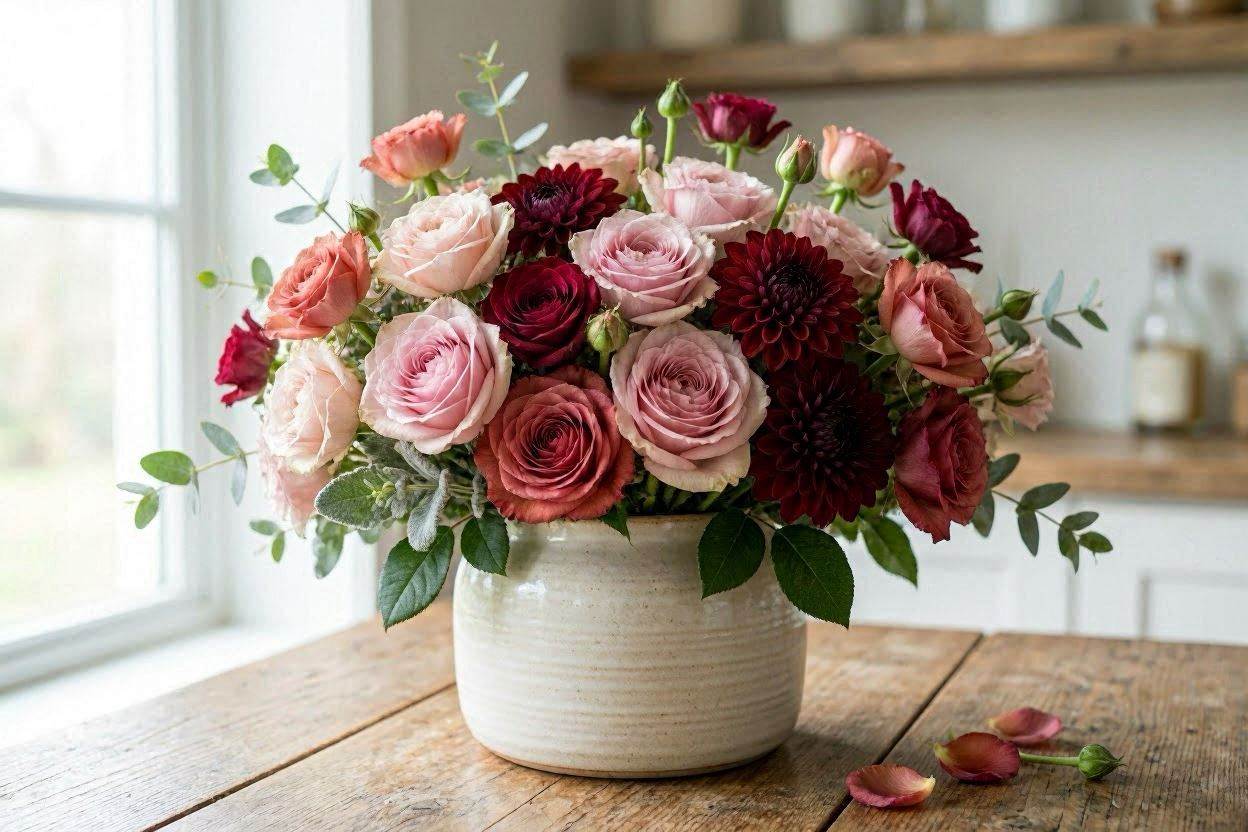 If color is the soul of a bouquet, then form is its body. The shape of an arrangement determines how it occupies space, how it draws the eye, and how it communicates its message. The difference between a forgettable bouquet and an unforgettable one often comes down to nothing more than form.
The Principle of Visual Wholeness
A harmonious bouquet is one where the totality of the arrangement creates a shape that feels complete and resolved. In classical floral design, this means symmetry — a rounded mass where no single element juts out awkwardly or leaves an uncomfortable void. The eye should travel across the arrangement and find rest, not restlessness.
Yet there is a powerful exception. The most arresting contemporary bouquets often reject symmetry entirely. Asymmetrical arrangements — bold, unconventional, sculpturally daring — command attention precisely because they break the expected rhythm. Their unusual silhouettes create tension, and tension creates intrigue.
Iconic Bouquet Forms
The pantheon of bouquet shapes is surprisingly diverse, each with its own character and ideal context:
The Round Bouquet — The most classic and versatile form. Its gentle spherical lines create a sense of completeness and warmth. Unfailingly elegant, it is an inspired choice for a bridal bouquet or a romantic first encounter.
The Cascade — Waterfall-like and dramatic, the cascade bouquet tumbles downward in a controlled flow of blooms and trailing foliage. It possesses a regal, theatrical presence that makes it a perennial favorite for formal weddings — though its impracticality demands a confident bearer.
The Linear Bouquet — Built upon the architecture of tall, strong-stemmed plants, the linear arrangement uses structural stems as its backbone, layering smaller blooms and delicate accents along their length. The result is a composition that feels both substantial and refined — flowers as architectural statement.
The Cone — Tapering from a full crown to a narrow base, the cone bouquet brings a sense of occasion and formality. It carries a certain old-world gravitas.
The Structural (Freestyle) Bouquet — Bound within a wire or organic frame, these freestyle compositions allow for ambitious, sculptural shapes that defy convention. They are the choice of florists who view arrangement as installation art.
Beyond these primary forms, there is an entire category of composition that dispenses with the traditional hand-tied bouquet altogether. Flowers arranged in baskets and hatbox-style vessels offer a different kind of presentation — one that is simultaneously relaxed and considered, as though the blooms have simply settled into their container with effortless grace.
How Form Shapes Perception
The physical shape of a bouquet fundamentally alters how it is perceived. A round or spherical arrangement reads as generous, warm, and inviting. A tight, compact form conveys intimacy and restraint. But it is the deliberately asymmetrical bouquet — one that refuses to conform to any expected outline — that most reliably stops people in their tracks. These arrangements carry an edgy sophistication, a suggeston that the person who chose them sees the world a little differently.
Asymmetrical bouquets may take the shape of a triangle, a sweeping S-curve, or a confident diagonal. The greatest floral designers work to ensure that these compositions feel resolved from every angle — that whether viewed from across the room or up close, the arrangement maintains its visual integrity. This is the mark of true craftsmanship: a bouquet that feels inevitable, as though the flowers could not have been arranged in any other way.
Choosing the Right Form for the Right Moment
- Weddings — Spherical and cascade forms remain the gold standards. The spherical bridal bouquet is practical, compact, and effortlessly photogenic. The cascade is for the bride who wants to make a grand entrance.
- For a gentleman — A vertical bouquet with clean, architectural lines and minimal embellishment. Masculine floral design favors restraint, structure, and a palette of deeper, more saturated tones.
- Milestones and jubilees — Voluminous, generous arrangements that fill the arms and fill the room with their presence.
- Extraordinary occasions — Asymmetrical, sculptural forms that signal this is not an ordinary moment.
- For a woman — Nearly any form can be made to feel personal and meaningful; the choice should reflect her sensibility, not a prescribed rule.
The尾声 of Care: Preserving Beauty Beyond the Moment
A bouquet’s story does not end at the moment of delivery. How a collection of flowers is tended in the days that follow determines whether it was a fleeting indulgence or a lasting pleasure. With proper attention, most arrangements will maintain their freshness for seven to fourteen days — a significant extension that rewards even minimal effort.
Acclimatization and First Steps
Resist the instinct to plunge a newly arrived bouquet into water immediately. When flowers are brought in from the outdoors, they need time to acclimatize to their new environment. Allow the arrangement a few hours to adjust to the ambient temperature of the room before placing it in a vase. This simple patience pays dividends in longevity.
Additionally, always seek freshly cut flowers when purchasing. Blooms that were harvested days ago may still look presentable, but their internal reserves are already depleted — no amount of care will restore the freshness they have lost.
Once arranged, keep flowers away from drafts, direct sunlight, and heating sources. Radiators and air conditioning vents are the silent enemies of cut flowers.
The Ritual of Maintenance
To extend the life of your bouquet to its fullest potential, adopt these practices as ritual rather than chore:
- Choose the right vessel — Select a vase that gives every stem adequate space. When flowers are packed too tightly, they compete for water and their petals compress unnaturally.
- Trim mindfully — With every water change, recut each stem at a sharp diagonal, removing approximately two centimeters. This opens fresh vascular tissue and allows the flower to drink efficiently.
- Refresh the water — Change the water before it has a chance to cloud. Stale water breeds bacteria that travel up the stems and accelerate decay.
- Strip the lower leaves — Ensure no foliage sits below the water line. Submerged leaves decompose rapidly, contaminating the water and shortening the life of every bloom in the arrangement.
- Nourish — Whether you use a professional floral preservative or a homemade solution of sugar and a few drops of vinegar, nourishment makes a measurable difference. Think of it as a multivitamin for your flowers.
Knowing Your Flowers
Every variety has its own temperament. Roses, for all their beauty, are notoriously particular — they wilt in warm environments and bristle at drafts. Some flowers, like certain orchids, prefer the cool stillness of an air-conditioned room. Others thrive in brighter, warmer conditions. Understanding the天性 — the essential nature — of the flowers you have chosen allows you to position them in your home where they will be happiest, rather than where they will merely be most visible.
The difference between a bouquet that fades in three days and one that remains radiant for two weeks is rarely a matter of luck. It is a matter of attention — the same quality of attention that guided the selection of each bloom in the first place.
Flowers, at their best, are a conversation between nature and intention. They are not merely beautiful objects to be purchased and placed — they are compositions to be considered, curated, and cared for. When treated with the seriousness of purpose they deserve, they reward you not just with color and fragrance, but with a daily reminder that the most meaningful luxuries are those that engage all the senses and speak directly to the heart.