
Luxury without health is just decoration. You can drape yourself in the finest fabrics, seat yourself at the most coveted tables, and curate a life that photographs beautifully — but if your nervous system is frayed, your hormones are in chaos, and your phone has colonized the last quiet hour of your day, you’re not living well. You’re performing well. The difference matters more than most people are willing to admit.
The wellness industry sells complexity — devices, protocols, subscriptions, supplements stacked so high they need their own furniture. But the most powerful interventions are disarmingly simple. Not easy — simple. There is a profound difference. The four pillars that follow require no app, no membership, no six-week program. They require something far more demanding: your attention, a willingness to be honest with yourself, and the discipline to do less of what harms you and more of what actually sustains you.
This is not a listicle. It is a manual for people who have realized that the most luxurious thing you can possess is a body and mind that function as they were designed to — and who are ready to do the unglamorous, quietly transformative work of getting there.
The First Pillar: Put the Phone Down
There is a moment, just before sleep, when the world shrinks to the size of a glowing rectangle. You know the one. The bedroom is dark, the day is over, and instead of closing your eyes and letting your mind unspool, you scroll. One more article. One more message. One more video that you will not remember in the morning. The phone promises one final hit of stimulation; your body promises nothing except the slow, compounding interest of exhaustion.
The science has been unambiguous for years. The blue-spectrum light emitted by screens suppresses melatonin production by up to fifty percent, delaying sleep onset and degrading the architecture of rest itself. But the deeper damage isn’t chemical — it’s attentional. Every late-night scroll trains your brain to outsource its winding-down process to an external device, rather than developing the internal rhythms that sleep requires. You’re not just losing an hour. You’re losing the ability to transition naturally between waking and rest.
A digital detox does not mean throwing your phone into the sea and moving to a cabin. That fantasy is its own form of avoidance — the belief that the solution requires dramatic rupture rather than small, consistent boundaries. The real intervention is modest and uncomfortable: thirty minutes before sleep, the phone goes elsewhere. Not facedown on the nightstand. Not on silent. Elsewhere. In another room, charging, out of arm’s reach and out of mind.
What fills those thirty minutes matters. A paper book — the kind with pages you turn, not swipe — invites a different quality of attention. Slower, more absorptive, less stimulating. If reading isn’t your temperament, then a brief walk, a few minutes of stretching, or simply sitting with your own thoughts in the dark. The initial restlessness is not a sign that the practice is failing; it is a sign that it is working. Your attention has been so over-stimulated that stillness feels like deprivation. In time, stillness begins to feel like what it actually is: relief.
Beyond the bedroom, the discipline extends to how you inhabit your waking hours. Social media platforms are engineered to maximize engagement — which is a polite word for extraction. Every notification is a micro-demand on a cognitive system that was never designed to process this many micro-demands. Blocking access to the most compulsive apps during work hours, or setting hard limits on when you check messages, isn’t restrictive. It’s restorative. You are reclaiming the capacity to be present — in conversation, in work, in the quiet spaces between obligations where creativity and reflection actually live.
And then there is the most undervalued benefit of all: real human connection. The dinner where phones are absent from the table. The walk where no one is documenting the view. The conversation where eye contact is uninterrupted by a glowing screen. These moments are not nostalgic luxuries; they are the raw material of emotional health. Every hour you spend curating your online presence is an hour you are not spending being present with the people in front of you. Choose accordingly.
The Second Pillar: Step Into the Light

If someone told you there was a free intervention that regulated your circadian rhythm, stabilized your mood, protected your cardiovascular system, supported bone density, improved sleep quality, and reduced your risk of depression — you would pay handsomely for it. The intervention exists. It is sunlight. And most people reading this are not getting enough of it.
The numbers are striking. Research indicates that over the past generation, the average person’s time spent outdoors has dropped by roughly seventy percent. We have engineered an indoor existence that prioritizes convenience over biology, and the consequences are measurable: suppressed melatonin cycles, diminished vitamin D synthesis, elevated cortisol, and a quiet but persistent erosion of mood that most people attribute to stress or aging when, in fact, it is partly a light deficit.
Dr. Joel Furman’s research on the relationship between natural light exposure and human health reveals a cascade of effects that extend far beyond the well-known vitamin D story. Insufficient sunlight disrupts the suprachiasmatic nucleus — the brain’s master clock — leading to irregular sleep-wake cycles, flattened mood, and a measurable increase in the risk of clinical depression. Vitamin D deficiency, meanwhile, has been linked not only to bone loss and cardiovascular disease but to hair thinning, metabolic dysfunction, and type 2 diabetes. The skin, too, suffers: blue-light exposure from screens — the same blue light that steals your sleep — has been shown to reduce skin vitality by up to thirty percent, accelerating the visible markers of aging that no serum can fully reverse.
The prescription is almost embarrassingly simple: five minutes of outdoor daylight, minimum, every single day. Not through a window — glass filters out the UV wavelengths your body needs. Not at noon if you live in a harsh climate — morning or late afternoon light is gentler and still effective. Just five minutes of unfiltered sun on skin and retina, enough to signal your biological clock that it is daytime, enough to begin the cascade of hormonal and neurological responses that keep your systems calibrated.
If you can manage more, do. A twenty-minute walk in morning light is one of the most effective mood stabilizers available without a prescription. A lunch break spent on a bench rather than at a desk under fluorescent tubes. A weekend morning where the first thing you reach for is not your phone but your front door handle. These are not heroic acts. They are corrective ones — small reparations for a lifestyle that has severed us from the most fundamental environmental signal our species evolved alongside.
Think of it this way: every other wellness practice you undertake — the nutrition, the exercise, the meditation — operates on a body that is either synchronized or desynchronized with its natural environment. Sunlight is the synchronizing force. Without it, you are optimizing a system that is running on the wrong time zone. With it, everything else you do has a firmer foundation.
The Third Pillar: Feed Your Hormones, Not Just Your Appetite

There was a time when eating well meant avoiding the obviously harmful: less sugar, less processed food, fewer calories than you burned. That framework isn’t wrong — but it’s incomplete. It treats food as a question of input and output, energy and restraint. What it fails to capture is that food is also information. Every bite you eat sends molecular signals that modulate hormones, regulate inflammation, reshape your gut microbiome, and influence the very architecture of your brain. You are not merely fueling a machine. You are programming one.
The Mediterranean diet has earned its reputation as the gold standard of evidence-based nutrition, and the research keeps compounding. Dietitian Maggie Moon’s work has demonstrated its neuroprotective effects — specifically, its capacity to reduce Alzheimer’s risk through a combination of polyphenol-rich vegetables, omega-3 fatty acids, and anti-inflammatory compounds that collectively support cerebral blood flow and neuronal integrity. This isn’t a trend. It is the dietary pattern most consistently associated with longevity and cognitive health across multiple large-scale, longitudinal studies.
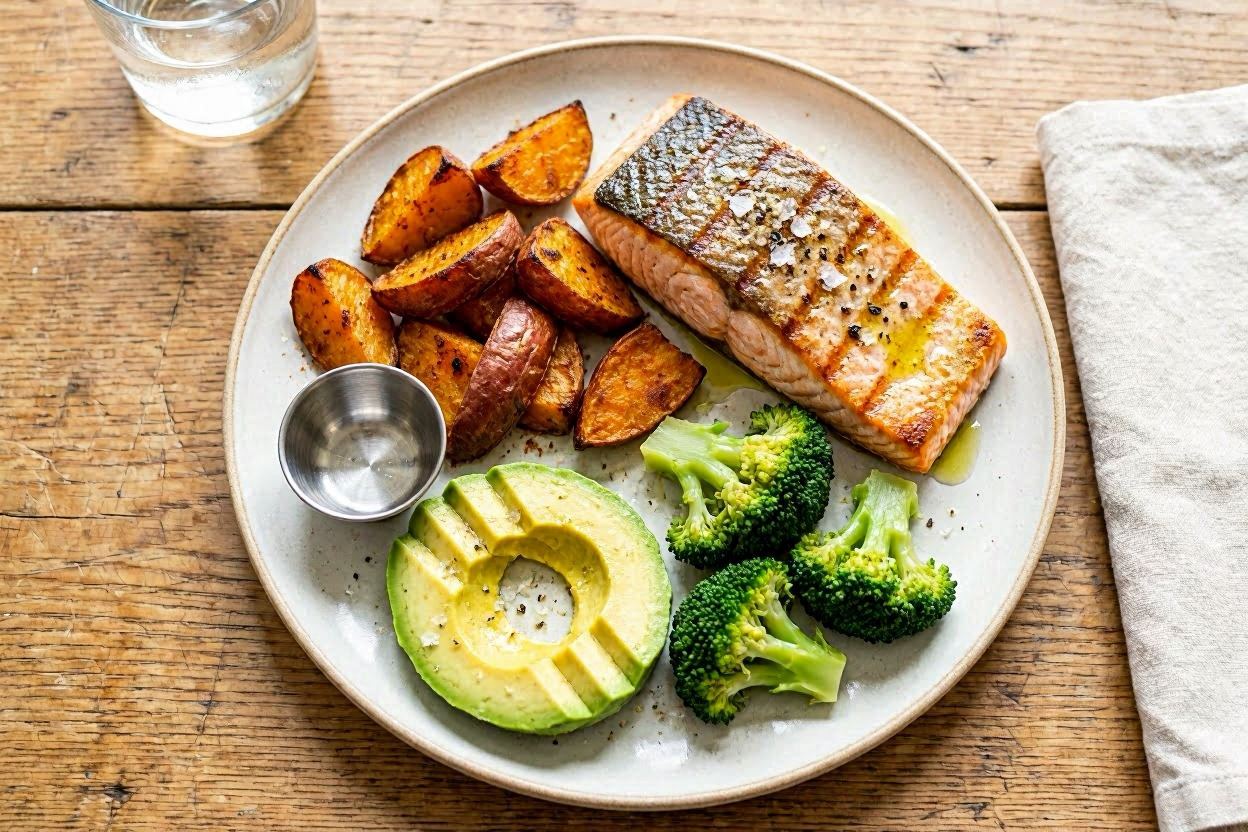
But within the broad umbrella of Mediterranean eating lies a more specific and powerful insight: certain foods directly modulate hormonal balance. Cruciferous vegetables — Brussels sprouts, broccoli, kale, cauliflower, bok choy — contain a compound called indole-3-carbinol, which the body converts into diindolylmethane, or DIM. This compound plays a critical role in estrogen metabolism, promoting the production of favorable estrogen metabolites while suppressing the more proliferative ones. For women navigating hormonal fluctuations — from PMS to perimenopause — this is not a dietary footnote. It is a foundational strategy. And for men, the benefits extend to testosterone regulation and reduced risk of estrogen-dominant conditions.
Healthy fats are the other half of the hormonal equation, and they have been needlessly villainized for decades. Avocados, coconut oil, raw nuts, and ghee are not indulgences to be earned — they are structural necessities. Hormones are built from cholesterol and fatty acids. A diet chronically deficient in dietary fat is a diet that starves the endocrine system of its raw materials. The result: erratic energy, mood instability, disrupted menstrual cycles, and a body that conserves fat rather than metabolizing it — because from an evolutionary perspective, fat scarcity signals famine, and famine triggers storage.
For those dealing with specific health conditions — particularly women experiencing hormonal disorders, autoimmune flare-ups, or chronic inflammation — the targeted removal of gluten and dairy can serve as a powerful diagnostic and therapeutic tool. Not because these proteins are universally harmful, but because individual sensitivity is real and underdiagnosed. A four-week elimination followed by careful reintroduction provides more personalized nutritional data than any generic meal plan ever could.
The nutritionist Dana James has articulated this with particular clarity through her four-archetype framework: the idea that different personality and metabolic profiles require different nutritional strategies. The approach is not one-size-fits-all; it is one-size-fits-you. And that philosophy — food chosen not for its moral valence (clean, guilty, sinful) but for its functional effect on your specific biology — is the hallmark of hormonal nutrition done right.
Every meal is a molecular decision. Make it a deliberate one.
The Fourth Pillar: Know What You Feel Before You Act on It
Emotional intelligence was once dismissed as a soft skill — the province of therapists, facilitators, and people who cried at commercials. That characterization has aged poorly. Since the concept was formally defined by psychologists John Mayer, Peter Salovey, and David Caruso in the early 1990s — and then propelled into mainstream consciousness by Daniel Goleman’s landmark 1995 book — the evidence has accumulated with quiet relentlessness. EQ is not a personality trait. It is a measurable, trainable capacity that predicts outcomes more reliably than IQ in domains that matter most: leadership quality, relationship stability, physical health, and the ability to navigate adversity without self-destructing. This is not therapeutic navel-gazing. It is operational. The executive who can identify the precise emotion driving an impulsive decision — anxiety masquerading as urgency, insecurity dressed up as conviction — has access to a choice that the emotionally undifferentiated executive does not. The partner who can distinguish between frustration and disappointment, between fatigue and disengagement, can respond to what is actually happening rather than reacting to what they assume is happening. The quality of your life is, in large measure, the quality of your emotional vocabulary.
And then there is the capacity to manage emotion — not suppress it, not transcend it, but work with it. High EQ does not mean never feeling anger, envy, or fear. It means feeling those states fully and choosing a response that serves your long-term interests rather than your short-term impulses. This is the discipline that separates the person who sends the blistering email and spends three days repairing the damage from the person who pauses, identifies the emotion, and addresses the underlying issue directly. Same initial feeling. Radically different outcome.
Research consistently confirms that high emotional intelligence correlates with lower cortisol levels, stronger immune function, better cardiovascular markers, and more satisfying relationships. The mechanism is not mysterious. Chronic emotional suppression and reactivity produce sustained stress-hormone elevation — the same cortisol cascade that sleep deprivation and financial anxiety generate. Over time, this physiological wear accelerates aging, impairs immunity, and undermines every other wellness practice you have invested in. You cannot supplement your way past an emotional life that is running you ragged.
Conversely, emotional competence — the ability to name what you feel, to sit with discomfort without being driven by it, and to extend that awareness to the people around you — creates a kind of psychological safety that is its own form of wealth. It is the foundation of trust, the precondition for authentic connection, and the single most underestimated variable in long-term wellbeing.
Begin simply. The next time a strong emotion arrives — irritation, excitement, dread — pause long enough to name it. Not “I’m stressed,” which is a weather report. The specific name: “I feel overlooked.” “I feel anticipated.” “I feel trapped between obligation and desire.” The more precise the label, the more control you retain. This is not self-help sentiment. It is neurology: labeling an emotion activates the prefrontal cortex and dampens the amygdala’s threat response. You literally think your way out of hijack.
Where These Four Meet
Read these pillars together and a pattern reveals itself. Each one addresses a different form of modern overexposure and under-nourishment: the digital detox corrects attentional overstimulation; sunlight corrects environmental deprivation; hormonal nutrition corrects informational starvation — feeding your body signals it recognizes and can use; emotional intelligence corrects reflexive reactivity with conscious response.
None of these pillars requires reinvention. They require return — to rhythms, environments, foods, and internal practices that your body already knows how to use. The smartphone is the anomaly, not sunlight. Processed food is the aberration, not broccoli. Chronic emotional suppression is the learned behavior, not the capacity to feel and choose.
Start wherever the gap is widest. If your phone is the last thing you see at night, start there. If you cannot remember the last time you stood in unfiltered sun, step outside tomorrow morning. If your dinner plate is beige and your hormones are erratic, add one cruciferous vegetable and one source of healthy fat tomorrow evening. If you cannot name the emotion that drove your last decision, pause the next time one rises and give it its proper name.
Do not attempt to renovate everything at once. That is the trap of the wellness industry — the grand plan, the total overhaul, the new identity. Lasting change is built in small acts repeated with attention. Thirty minutes without a screen. Five minutes of sun. A meal chosen for function, not habit. A feeling named before it is acted upon.
Luxury without health is just decoration. But health attained through these four pillars — intentional, evidence-based, and genuinely personal — is not a trend. It is the architecture of a life that doesn’t just look good but feels good, functions well, and endures. The truest luxury is a body and mind you can rely on. Build them one quiet pillar at a time.